Posts

Showing posts with the label Slugs

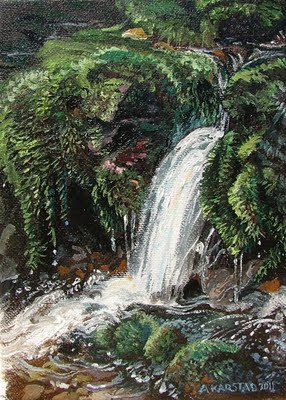
Water Shrew Habitat (oil on canvas 5 x 7 in.) Sold
Image
6 July finds me alone for most of the day to paint a little waterfall on a tributary to Canada Brook in the Caledonia Gorge PNA, New Brunswick.  On a rainy day last week Don took a photo of this creek with torrents of water rushing over the mossy rocks, but now the water is quietly trickling under most of the rocks, and only falling noisily in a few places like this.  I have chosen the larger of two falls side by side. The splash and wet moss from the smaller can be seen at bottom right. This is near the location of the Bio-blitz's only Water Shrew. They are not vulnerable to the kinds of traps that mammalogists set, so no one knows how rare or common they may be. Fred and I have caught them occasionally all across the country in minnow traps set for salamanders. A Tiger Swallowtail butterfly courses across my scene and lands on a Hobblebush just above my head. There must be birds about too, but I can't hear their songs over the rushing of water. Choosing a spot has been ...

The Giant Urban Slug Lays Eggs

Image
Attending the egg-laying of this amazing creature was a 'formative' experience for me.  Since I wrote this journal page (detail shown above - full page shown below), we have been launched into a survey of giant urban slugs - by the enthusiastic public response to an article in the Toronto Star .  I received over 30 e-mails about giant slug sightings from Burlington to Bowmanville, and ranging as widely as Rockwood and Wiarton.  There was even mention of them being seen in Sudbury, but the identity there is still in question. We made a map of localities at  http://www.doingnaturalhistory.com/?p=37 where people can post comments and watch the progress of the survey.

Painting slugs from photos

Image
Limacus flavus Barbara Nitz sent me excellent photos of Limacus flavus from Germany, so I began with this species. The slugs in her photos varied in colour from dark brown, through green, to orange. The only direct side view was taken of the most orange individual, so that is the one I used as reference. Luckily Barbara had also taken dorsal photos of this animal, so I didn't have to guess at the pattern. I learned how to most easily transfer the measurements and proportions of a slug in a photos to the page. My photos are on the computer, each view in a separate "viewer" window. First I decide how long the painted slug is to be, relative to other species I have painted. I measure the length on paper and then drag the corner of the viewer window until the size of the photo corresponds to the size that the illustration will be. As I proceed to draw, I measure each part of the slug in the photo. As with all the other species (below) that I have had to paint withou...

Shipped live from Washington state

Image
Arion species (unidentified) This slug is so long and extensible - elastic! When resting it has a usual Arion shape, and can hump itself up into a rectangular lump when disturbed (which Arion circumscriptus cannot do), but while crawling, it just stretches longer and longer! In order to show an average aspect, I don't paint my slugs fully extended, so this portrait does not show this beast at its extreme, which is at least another 5 mm. It is not particularly shy, willing to wake up and walk about when nudged gently, or when its substrate is tilted or rotated. It had two wounds made by the fast, agressive little Deroceras panormitanum - luckily on the left side, as my portrait is of the side with the pneumostome. When I first opened the lid upon receiving the parcel from Washington state, I noticed one of the Deroceras following a slowly crawling Arion , and biting its tail! I immediately found several plastic sandwich containers and began to isolate all of the Deroceras,...

Bananaslug - really!

Image
Ariolimax columbianus Jane, our intrepid British Columbia slug hunter searched for the alien Worm Slug (Boettgerilla pallens) without success on Vancouver Island this fall, but she did capture a native Pacific Bananaslug (Ariolimax columbianus) in Vancouver. She made a liason with the Malacologist Robert Forsyth at the Vancouver airport, just as he was about to board a plane to Ottawa to attend COSEWIC (Committee On the Status of Endangered Wildlife In Canada) meetings, and slipped him the container, which he carried onto his flight and passed to me as I met him at the Lord Elgin Hotel. The giant slug (120 mm) was alive and well, though it had thoroughly slimed up the moss and paper towel in its container. The skin of this beast is amazingly slick. Although the body has longitudinal grooves, they are finely incised on a smooth flat surface, nothing like the tubercular ridges of Limax maximus. The colour is like green pea soup, except that the foot fringe pales to yellow toward the ...

Another batch of slug watercolours

Image
Deroceras reticulatum I have just finished the third dorsal view of this ubiquitous slug introduced from Europe, Deroceras reticulatum , the milky-slimed muncher in every garden, variable in colour and fast moving. You can see the flat spot in the rear portion of its mantle, where the vestigial shell sits, internally. The finger-print wrinkles are slighter just over this bit of shell that reminds us that slugs are relatives of snails. It has two characteristics that make it easy to tell apart from its native cousin D. laeve . D. reticulatum has a large pale area surrounding its pneumostome, or breathing hole, and when the animal is touched, it exudes exceedingly sticky white mucous which is hard to get off your hands, and can cause dermatitis in the slug collector. The lateral view and first dorsal view were painted from a 45mm individual collected by Judy Courteau, from under an Elm tree near Dunville, Ontario, on 23 September. The second dorsal view was collected by Fred, from ...

Limax maximus art critic

Image
The Giant Garden Slug, Limax maximus, has charmed me again. I haven't seen one since I was four years old, in Seattle, Washington. The subtle colours, the handsome spots and stripes, the graceful reaching, tentative progress, delicate cool touch - I've been enthralled and delighted all over again as I turned the scrap of dampened board this way and that to orient the creature according to my painting as it crawls, like the Red Queen in Alice in Wonderland.... faster and faster just to stay in the same place. This individual was collected along with a young one, in a tangled copse of mixed woods in a town on Georgian Bay named Dyers Bay on the Bruce Penninsula, Ontario, in August of this year. This marvelous mollusc is about 12 centimetres fully extended, and I think it is not quite full grown!

Slugging Away!

Image
Prophysaon andersonii , one of the tail-dropping slugs from British Columbia. 50mm head to tail. You can see the change in texture , diagonally, about a quarter of the way forward from the tip of the tail. I didn't challenge it to drop its tail, for obvious reasons. The interesting thing about the personality of this slug was its liking for doubling back on itself - turning and crawling alongside its body. Another BC slug, Arion subfuscus . 35mm head to tail. This species likes to curl into a circle to rest, head to tail-tip, which gives me the impression of a child sucking its thumb. Arion slugs seem dense and muscular, and their tails have a ribbed texture. This massive black Arion slug is now called Arion rufus after the reddish colour phase. But I prefer the old name, Arion ater, which I believe means "black". Totally awesome, this beast! The first one I ever saw in the wild was in a roadside bed of tall Horsetail on Vancouver Island. I shouted excitedly to...

Philomycus togatus, the Toga Mantleslug

Image
Another slug painting, this one I expected to be difficult, as it is deliberately indistinct in pattern - obviously trying to look like a bird dropping, decomposing fungus, or some other bit of organic muck. Philomycus is a forest slug, and there are other species, but in the east we have only togatus . I found this one resting in the shadow of a well-rotted, mossy branch of White Birch on the forested southeast facing slope just above a newly gravelled laneway leading into a recently surveyed potential cottage lot. Fred is checking a block of four surveyed lots for the presence of Black Rat Snakes on the shore of Big Rideau Narrows, across from Murphys Point Provincial Park, and I accompanied him on his first visit to the site. The ground was dry, as it has been unseasonably warm and sunny for early May - and I was surprised to find the slug so exposed. It was lying full length but with eye stalks retracted, and when I touched it to see whether it could be roused into activity, it c...

Lehmania valentiana

Image
Judy collected 15 slugs from beneath flower pots in a Richmond greenhouse on 19 February, for me to paint for the book "Identifying Introduced Land Snails and Slugs in Canada, With a Guide to Native Genera". I've been keeping them in a clear plastic salad box with damp paper towel, crushed eggshell, and romaine lettuce, calling them "my little pigs" for the way they devour the lettuce, turning the heavy-veined leaves into soggy lace, and then lying packed together in clusters like miniature piglets, sleeping it off. They have also been laying eggs, which you can see glowing like a mass of pearls through their translucent sides - most visible on the right hand side. There are paler and darker individuals. The darker ones appear to be more mottled, and the paler ones show the characteristic "watery tail". The slime is clear and the breathing hole, or pneumostome, has a pale rim. The best character for identification of this rather nondescript lookin...