Posts

Showing posts with the label Bio-blitzes

Ponera Ants on Cladonia

Image
Ponera Ants on Cladonia (8 x 8 in. watercolour) 10 August 2017 found me in Spednic Lake Protected Natural Area, near McAdam, New Brunswick, following Aaron Fairweather around as he collected ants. Traveling light that year, I had decided that all my paintings for the New Brunswick Museum's BiotaNB survey would be in watercolour - a couple of scenes, and several wildflowers... and this painting of a few of the ants we collected, shown exploring a tuft of the Gray Reindeer Lichen, Cladonia rangiferina that was growing near their nest. Ponera pennsylvanica live in small colonies of no more than 60 workers, under stones and in rotting wood, foraging out singly for mites, springtails, and small insects. They are very tiny ants, only about 2.5 mm in length, so I was able to use one of the museum's microscopes to begin the painting in the BiotaNB lab set up in the Lion's Hall in downtown McAdam. For lifelike poses I referred to YouTube videos of this species in captiv...
Making it Across

Image
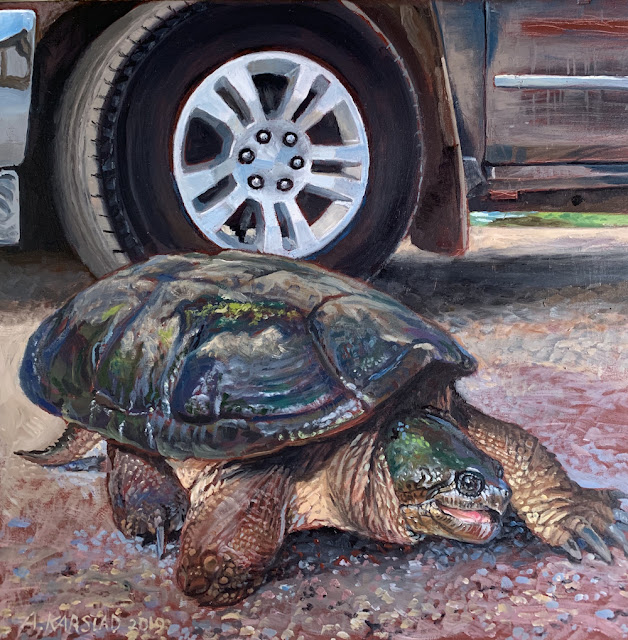
"Making it Across, Spednic Snapping Turtle" (oil on canvas 10 x 10 in.) It's a hard life, being a turtle! I painted this portrait of a Snapping Turtle, from a photo taken by Don McAlpine of the New Brunswick Museum, in June last year at the BiotaNB survey of Spednic Protected Natural Area, near McAdam, NB. It was crossing the road at the bridge over Diggity Stream. I've shown a thin strip of riverbank beneath the truck, and a reflection of part of the bridge in the chrome bumper, but most of the painting is devoted to the task at hand - Making it Across. The truck, in the original photo, was parked on the far side of the road, but in planning the painting, I took a reference photo of a truck wheel from a more ominous perspective - that of a crossing turtle. I wanted it to look as if the driver has rolled up close to watch it cross and to hurry it along. Or maybe the truck is threatening the plodding reptile - defending the road as Truck Territory. Snappers r...

New Brunswick Pseudoscorpion

Image
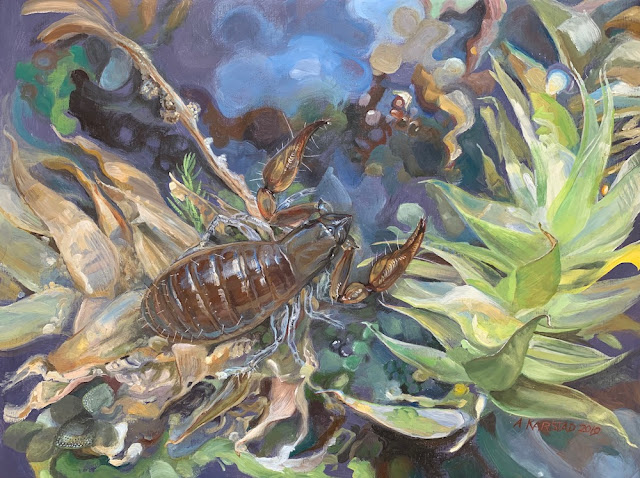
"New Brunswick Pseudoscorpion" (oil on birch panel 12 x 16 in.) On 28 June 2019 , two days into this year’s BiotaNB survey as “Resident Artist” in the Kennedy Lakes Protected Natural Area, I found myself sliding down through the ocular tubes of a microscope, into the worlds of Rotifers and Water Bears.  As the botanists, returning to the lab trailer from their field excursions, identified their collections of fungi, mosses, and Liverworts, one of them called my attention to a Pseudoscorpion he’d found wandering among tiny mosses as if they were trees and bushes.  Pseudoscorpions are tiny predators, catching and eating anything smaller than themselves - mites, nematodes, and tiny larvae of this and that. The Pseudoscorpion we see most often is a little larger than the one I’ve painted here - the indoors species, Chelifer cancroides , is a welcome symbiont in pantry and closets. This one is as yet unidentified - the shape and proportions of claws to cephaloth...

White Pine Among the Boulders

Image
"White Pine Among the Boulders" (oil on birch panel 8x8 in.) 22 June 2018 found me sitting on a mossy boulder, painting the base of an imposing White Pine in the Spednic Natural Protected Area, east of McAdam, New Brunswick. This is hilly forested terrain, full of gullies and boulder fields. The others have driven on up the road, in search of earthworms, leaving me here to clamber over moss-blanketed boulders until I decide on a subject to paint. I took many photos of Yellow Birches perched on massive fern-fringed rocks, clasping them snakelike with gleaming naked roots, but couldn’t decide which would be best for a painting.  Finally I’d wandered up over the hill and looked down to a sunlit valley of ferns and bushes. There at its edge rose up before me the tremendous trunk (about 80 cm diameter) of a lone White Pine, a mighty column sculpted in bas relief by grooved and plated bark, and towering its fine-needled crown up against the sky. I considered looking u...

Spednic Lake Boulder

Image
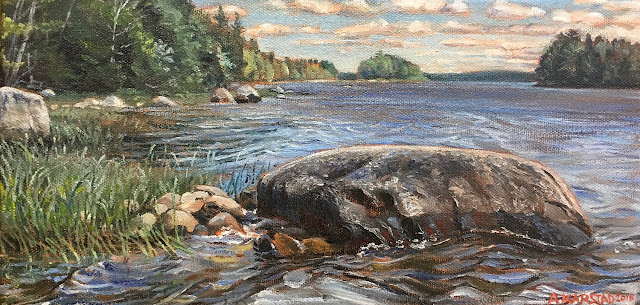
"Spednic Lake Boulder" (oil on birch panel 6 x 12 in. collection of New Brunswick Museum) On 19 June, 2018 Fred and I drove to Spednic Lake Provincial Park in one of the BiotaNB trucks, to explore and paint on the bouldery shore of Spednic Lake, the long lake that borders the Spednic Protected Natural Area near McAdam, New Brunswick. A brisk breeze was pushing low waves in long curving lines to slosh gently against the row of distinctive boulders of all sizes that countless winters of ice had pushed up against the shore. You can see the path through the lake edge grass, made by the gradual movement shorewards of the boulder on the far left of my painting. Poet in Residence Harry Thurston and I explored a few hundred metres of the shore, careful not to twist our ankles while stepping from rock to rock, and admiring green Dragonflies just emerging from the skins of their final aquatic nymphal stage that were still clinging where they'd crawled out of the water to ...

Jake in Palfrey Creek

Image
"Jake in Palfrey Creek" (oil on birch panel 6 x 8 in. collection of New Brunswick Museum) The last of the series of portraits of biologists at BiotaNB, I finished this one of the young entomologist Jake Lewis, wading with his net, beyond the flaming spikes of Cardinalflower that bloomed so splendidly at that spot on Palfrey Creek in August. We were in the Spednic Protected Natural Area near McAdam, New Brunswick in our first of the two-year survey of this PNA. I delivered the finished painting this year. For my smaller oils I am now using birch panels instead of stretched canvas, and enjoying the satiny feel of each stroke, and its ready acceptance of the paint, with no struggle to fill the weave of the canvas. I'm pleased with the likeness of Jake, and everyone at BiotaNB recognized him immediately - quite the accomplishment with a full figure of less than 2 inches high! "Jake in Palfrey Creek" detail

Biologists With Maps - BiotaNB

Image
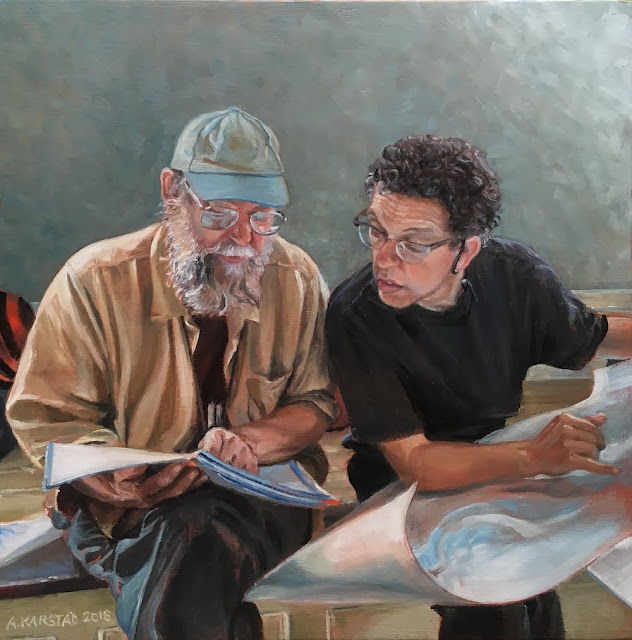
"Fred and Don With Maps" in the Gagetown Courthouse, BiotaNB2016 (oil on birch panel 10 x 10 in.) collection of NBM This is my ninth consecutive year as "Artist in Residence" at BiotaNB, the two-week long biotic inventory of New Brunswick's "Protected Natural Areas", held by the New Brunswick Museum. My husband Fred is one of the 30 or so biologists, invited from all across Canada and beyond - and since my mandate at last year's BiotaNB was to paint portraits, one of these was to be of Fred. I had taken a photograph at BiotaNB2016 in Gagetown, that has been crying out ever since to be painted - of Fred poring over maps of the Grand Meadows Protected Natural Area with Don McAlpine, the Head of Natural Sciences at the NBM. Biologists are usually solitary in study of the organisms they love - it requires a lot of "quiet curatorial time" as Fred says - so the drawing together of so many of these solitary specialists in the collabora...

Robinson Lake on the Dumoine River

Image
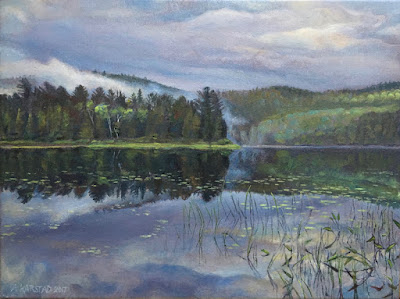
oil on canvas 12x16 in. $960 July 22, 2016 found me just getting up for breakfast at our Bio-blitz camp on the shore of Robinson Lake on the Dumoine River, ZEC Dumoine, Quebec. The sun was breaking through the clouds to illuminate the last of the lake mist, just drifting off the trees and reflecting itself in the mirror-still lake - but soon our hopes for a sunny day would be dampened entirely by heavy cloud and intermittent drizzle. I photographed the lake, with Pickerel weed leaves making angled reflections near shore, and the floating lily pads of Water Shield farther out on its glass-smooth surface. The subtle mood of the scene, although enchanting, would change in only a few minutes - too ephemeral for me to get my gear out and set up to paint it - so I decided to photograph it to paint later, and hike off to explore La Grande Chute for potential painting spots. I took my painting umbrella in case of showers - at first it served well as a walking stick, on the narrow undu...

Ancient Red Pine of Nepisiguit (oil on canvas 11 x 14 in.) Sold

Image
3 July 2015 finds me near the top of a mountain in the Nepisiguit Protected Natural Area near Mt. Carleton Provincial Park, New Brunswick. I'm sitting on a stump, leaning back against a fallen branch, and gazing up to paint a tall split-trunked Red Pine, waving its sunlit needles high against a cloud-tossed blue sky. Yesterday the Dendrochronologist (tree historian) of the BiotaNB team Ben Phillips, cored some big old trees up here and found that two Red Pines (both of them split identically into two equal tops) counted approximately 300 years old. This is a heretofore unmeasured age for Red Pine. These may be the oldest known individuals of this species in North America. So we mounted a second expedition, equipped with photographers (Steve and Nina Colwell) and an artist (myself) to hike back up today to further document the ancient Pines. We drove in and parked where a creek crosses the road, coming from a long thin Beaver dam, which we balanced along, with walking stick...

Grand Lake Meadows (oil on canvas 8 x 16 in.) Sold

Image
19 July 2014   found me standing in the back of a pickup truck on the causeway through the Grand Lake Meadows near Gagetown, New Brunswick, snapping pictures of my favourite scene at my favourite time of day. I'd been craning my neck at this spot, every time we've driven the causeway - several times during last year's Bio-blitz, and even more this year, as this is the second and last year of the all-taxon survey of the Gagetown area.

Grand Lake Mystery Snails (watercolour 4 x 5 in.) Sold

Image
12 August 2014 found me touching up one of my oil paintings in the Bio-blitz headquarters in the Courthouse Museum in Gagetown, New Brunswick, when Don McAlpine showed me the Chinese Mystery Snails that were collected in Grand Lake off French Island. I decided to paint them in watercolour. The the snail on the left has its aperture closed neatly by a horny "operculum" attached to the back of its tail, and the one on the right shows the eroded spire that

Hurricane Drift (oil on canvas 8 x 8 in) Sold

Image
On 11 August 2014 , Fred went out with Don McAlpine and Mary Sollows to Grand Point of  New Brunswick's Grand Lake, to search for specimens of Lampsilis cariosa that might have been thrown up by Hurricane Arthur.  This was (before our surveys during this Bio-blitz) the one known Grand Lake location of the Yellow Lamp-mussel,  which prefers sandy bottoms, mostly in rivers. It was at this spit of sand and fine gravel that the species had been taken from the lake in 2001. I've always found beach drift exciting as a subject for painting, and decided to do

Swamp Milkweed on Thatch Island (oil on canvas 7 x 9 in.) Sold

Image
12 August finds me on Thatch Island in the Grand Lake Protected Natural Area along the north shore of the Saint John River near Gagetown, New Brunswick. The meadows and marshes are glowing in the sun against the shady rows of trees that line the channels, and Kim Stubbs, the other Bio-blitz artist and I are setting up to paint riverine scenes. The sun is hot on Goldenrod, Evening Primrose, Angelica, and mints among the grasses around the cove where our boat is moored. The shade cast by the Silver Maples along the north shore's narrow channel is inviting as I try to find an exciting angle on the peaceful scene. Kim has her first painting half finished before I find the excitement I want - combining a distant scene with a botanical study. Bumblebees and Honeybees visit the bright flowers of the small compact panicles of Swamp Loosestrife bloom, at head height for me as I sit beneath my sunshade. An Osprey

French Island Forest (oil on canvas, 6 x 8 in.) Sold

Image
9 August 2014  finds me with other Bio-blitz participants on French Island, between French Lake and Indian Lake in the Saint John River, Grand Lake Protected Natural Area, New Brunswick. We came by boat across a narrow channel from Sand Point, and upon landing on the pebbly beach the ant collectors went east to a hillside of birches and cedars stepping up among slabs of sandstone, and the botanists went in the other direction. The Myxomycologist (slime mold specialist), the Mycologist

Sand Bay, Cockburn Island (oil on canvas 6 x 12 in.) Sold

Image
30 May 2014  found us at Sand Bay on the south shore of Cockburn (pronounced  'Coeburn') Island, a large island off the western tip of Manitoulin Island, a team of biologists led by Nature Conservancy staff.  When we arrived here at Sand Bay on Cockburn Island's Lake Huron shore in the early afternoon, wraiths of mist were drifting inland across the upper beach and over marshy pools bristly with Juncus reed, but as things warmed up the mist disappeared. I sat to paint in the shade of a Tamarack among mats of Horizontal Juniper on the low dunes, where larval Lacewings lurked in conical Ant Lion pits waiting for careless Ants, and Tiger Beetles with olive-coloured backs scooted between the reaching branch tips of the Junipers. Gray Treefrogs called from bushes where a little old log cabin faced the beach, backed in among tall Spruces.

Sandhill Crane Chick (watercolour 5 x 5 in.)

Image
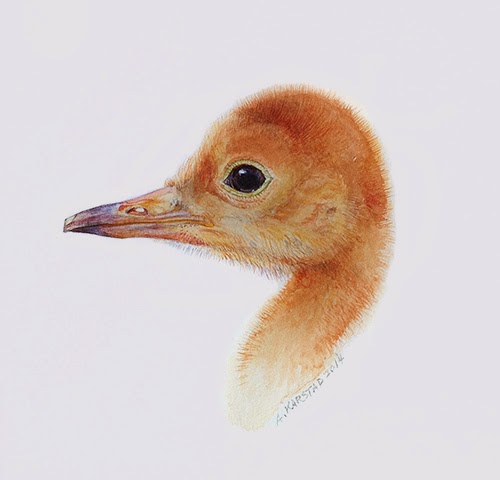
1 June 2014 found me exploring a wetland on a tributary to Sand Lake, 9.5 km south of Tolsmaville, on Cockburn Island, off the western tip Manitoulin. It was a cool sunny day and we stopped at a marsh where a team of visiting biologists had seen Painted Turtles and mating Snapping Turtles the day before, still hoping to find a Blandings Turtle. Beavers had piled mud and sticks against a grating that had been propped against the mouth of a culvert to baffle their attempts to stop the flow. Water was still flowing through the culvert in spite of the Beavers' efforts. Fred and the others noted three Painted

Scarred Aspen (oil on canvas 5 x 7 in.) Sold

Image
27 August finds me looking into the woods from the side of Frontier Rd, southeast of Carlsbad Springs, in eastern Ontario. Each time Fred and I drove past this tree today I've admired it - must be making a statement, to the artist in me at least, and perhaps of something deeper that does not come to me in words.  The Aspen rises from waves of Frangulous Buckthorn foliage which is in the process of engulfing the native willow bushes and Red Osier Dogwood, and the shadowed trunks of other Aspens make blue-grey lines in the background as the sunset twinkles through their branches. The space that makes for distance in my painting is an opening cleared by bulldozers, perhaps last summer. It enters at an angle from the road and then turns and runs straight, deep into the property, but that's not obvious from the road. For now I'll stay by the road to paint the scarred Aspen. Today we are participating in a "Bio-blitz" - an all-taxon biological survey of a pl...

Watercolours from the Bio-blitz at Grand Lake Meadows, New Brunswick - Sold

Image
28 June finds me painting the Succineid snails that we collected from a patch of Agelica and grass beside Highway 105 in the Grand Lake Meadows Protected Natural Area, New Brunswick. This was on 25 June as we left the Bio-blitz, heading for Ayers Lake. We stopped the van a little east of the Sunbury County line so that we could be sure that we were in one of the the narrow slices of land that make up the Grand Lake Meadows Protected Natural Area along Highway 105. I walked across the road to investigate a lush patch of Angelica. There they were, about twenty little amber snails less than two centimetres long, crawling on the leaves and stems, and also on blades of grass, in the shade of the Angelica in the mid-afternoon of a very hot day. These jewel-like land snails are very difficult to identify. We used to think that we could tell the species apart, but now that we know how many taxonomic problems have been found among them, including hybridization, without dissection I can...

Trout Brook Floodwaters (oil on canvas, 6 x 8 in.) Sold

Image
20 June finds me in a Silver Maple forest flooded by Trout Creek in the Grand Lake Meadows PNA, New Brunswick. I am painting the portrait of a tree that is extending a long horizontal limb, twisted and forked, in my direction. Its bark is shaggy with strap-like plates lifting at either end. This is not the largest tree on the clay floodplain. There is a several-trunked Silver Maple several metres away, standing amidst Sensitive Fern at the waters edge, and not far away in the other direction, a huge Green Ash tree, leans toward a Silver Maple as if in conversation. Its trunk is about a meter in diameter at chest height.  Barb Brown and I have followed this track deep into the Silver Maple forest, the trees getting older and larger with a more complete canopy the further down toward the Jemseg River we went, identifying tracks in the soft mud - Raccoon, Moose, Deer, and Bear. Barb walks farther on as I stay here to decide which trees to paint.

Burpee Millstream at Fernbank Road (oil on canvas 12 x 16 in.)

Image
18 June finds me sitting on my paint caddy by the Burpee Millstream in one of the western slices of New Brunswick's Grand Lake Meadows PNA, working to capture the patterns of light and colour of water as it courses past, and the rhythm of Red maple and White Pine branches as they reach into the light above the stream.  Fred has just returned from wading down the creek on the round cobbly rocks, admiring the aquatic moss and collecting spring drift from the floodline one metre up the bank. He found a Two-lined Salamander under a stone at the stream edge, and dipnetted a Stonefly larva. There were no crayfish, clams or snails, and no evidence of Beavers. Then he walked back through Sensitive Fern and waist deep Ostrich Ferns to check my progress on the painting.  Painting moving water is a time-consuming study, and I realize that whenever I'm not guessing, I'm learning.