Posts

Summer Calm South Nation (oil on canvas 8x8 in.) Sold

Image
19 June 2014 found me three kilometres northwest of Winchester Springs, Ontario, painting a view across the South Nation River from a steep grassy bank on its north shore. Tall grasses screened the river's edge. I flattened some of the Bromus and Reed Canary Grass into a nest for sitting to paint in the combined shades of a licheny sprawling Manitoba Maple and a stocky low-spreading Ash tree. The purpose of this visit was to explore this part of the South Nation River where the Trans Canada Pipeline crosses it. You can read more about this idyllic spot and what we found there at our Vulnerable Watersheds blog. 

Pulled Out to Stay (oil on canvas 6 x 8 in.)

Image
1 June 2014 found me on another Cockburn Island beach, called by the locals "Connell's Dump", used until 1960 as a depot for the lumber and pulpwood industry on the island. The Connells floated the logs off the beach in booms, which were towed around to the dock at Tolsmaville, some to be loaded onto ships, and some to be made into boards at the two local sawmills. The last of the logs still remain, with White Cedars growing up among them, behind the ridge

Sand Bay, Cockburn Island (oil on canvas 6 x 12 in.) Sold

Image
30 May 2014  found us at Sand Bay on the south shore of Cockburn (pronounced  'Coeburn') Island, a large island off the western tip of Manitoulin Island, a team of biologists led by Nature Conservancy staff.  When we arrived here at Sand Bay on Cockburn Island's Lake Huron shore in the early afternoon, wraiths of mist were drifting inland across the upper beach and over marshy pools bristly with Juncus reed, but as things warmed up the mist disappeared. I sat to paint in the shade of a Tamarack among mats of Horizontal Juniper on the low dunes, where larval Lacewings lurked in conical Ant Lion pits waiting for careless Ants, and Tiger Beetles with olive-coloured backs scooted between the reaching branch tips of the Junipers. Gray Treefrogs called from bushes where a little old log cabin faced the beach, backed in among tall Spruces.

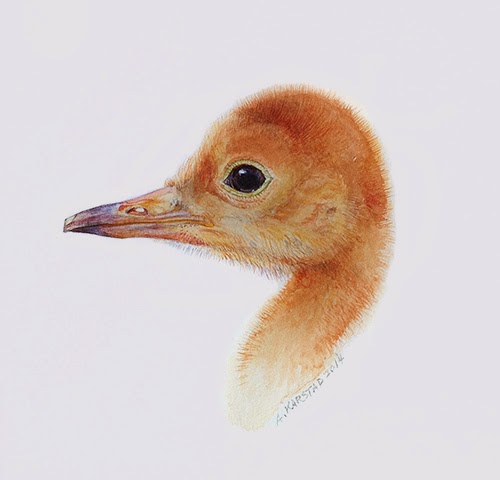
Sandhill Crane Chick (watercolour 5 x 5 in.)

Image
1 June 2014 found me exploring a wetland on a tributary to Sand Lake, 9.5 km south of Tolsmaville, on Cockburn Island, off the western tip Manitoulin. It was a cool sunny day and we stopped at a marsh where a team of visiting biologists had seen Painted Turtles and mating Snapping Turtles the day before, still hoping to find a Blandings Turtle. Beavers had piled mud and sticks against a grating that had been propped against the mouth of a culvert to baffle their attempts to stop the flow. Water was still flowing through the culvert in spite of the Beavers' efforts. Fred and the others noted three Painted

Flooded Fields (oil on canvas 6 x 8 in.)

Image
10 April finds me sitting in the car 1.5 kilometres south of home in Bishops Mills Ontario, painting the Streights' flooded cornfields. I came out late on this overcast day, hoping for some colour in the sky for a painting of flooded fields, as even on a very dull day there's usually a little colour near the horizon in the evening. Looking southwest around 6:00 pm today it's pale salmon. The Canada Geese which had dotted the watery field when I

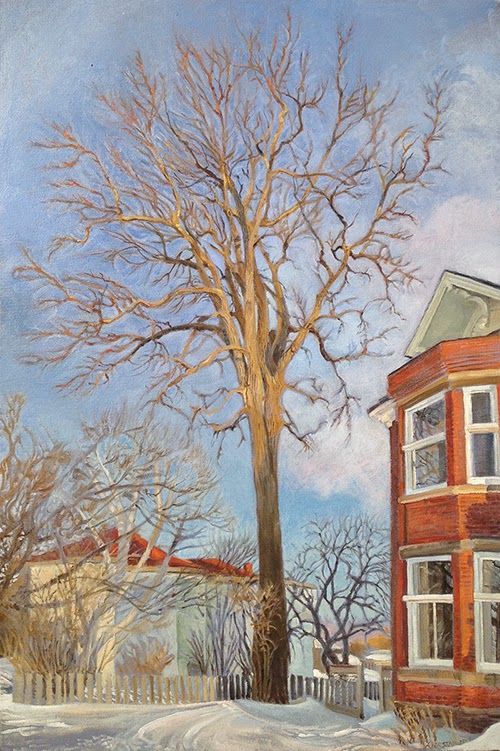
Merrickville Rock Elm (oil on canvas 24 x 36 in.) Sold

Image
"Rock Elm is one of those species which can leave an immediate impression on the observer" writes Owen Clarkin, who commissioned this painting. "It frequently develops a rugged growth form with deeply ridged mature bark, pendulous "claw-like" branches, and corky twigs.  To me this tree (the "Merrickville Monster") signifies how the common can become rare and eventually obscure, given that Rock Elm is poorly known to the public at present.  Rock Elm was historically documented as being a common tree in Ontario, being exported to England as square timber for shipbuilding (etc.) and supporting industries such as the manufacture of hockey sticks, piano frames, vehicle frames, and tool handles.  The wood of the species is one of the hardest, strongest, and toughest of any large tree, and it

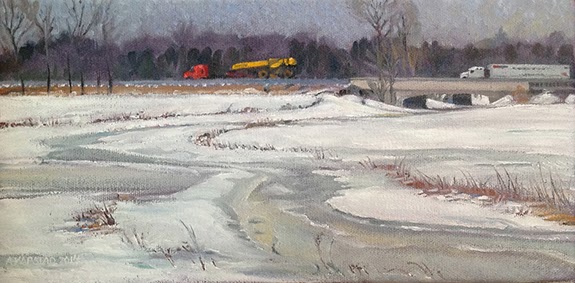
Icebound Treasure With Trucks (oil on canvas 6 x 12 in.)

Image
19 March 2014  finds me on County Road 14, 2.3 km NNW Ingleside, Ontario, looking across a snowy field where Hoople Creek winds toward the bridge on Highway 401. An intermittent stream of long trucks flows from east to west and from west to east, while the  creek itself appears motionless, its stream running beneath ice and snow - but I can see its path where water has melted and re-frozen, pale sea-green and amber.  We are 700 metres east-south-east of where the Transcanada and Enbridge cross Hoople Creek. This is the first of our visits to stream crossings along the route of the pipelines that are proposed to carry the Energy East bitumen to New Brunswick.